Local drain guide
What actually blocks drains in Hornsby
Roots go to water, not to pipes
A sound, sealed pipe is of no interest to a tree. What attracts roots is moisture, and a joint that has opened is a source of it.
So root intrusion is always downstream of a defect. The tree did not cause the problem, it found one that was already there.
That matters for the repair, because it means dealing with the tree and dealing with the cause are two different things.
Cutting clears today, it does not fix the cause
Mechanical cutting is the right immediate answer and we carry it. It restores the line and it gets the house working again the same day.
What it does not do is close the opening the roots came through, so they return, and the interval between visits shortens each time.
That is not a failure of the clearing. It is what clearing is, and it is worth understanding before booking the third one.
Which is why the tree rules matter to a plumber
Everywhere else, the endgame for a recurring root problem is removing the tree. In the Bushland Shire that option is frequently not available.
Hornsby's tree preservation controls are genuinely protective, and a mature tree on or near a property is not something an owner can simply decide to take out.
So the repair has to work with the tree staying, and that shapes everything on this page and on the relining page.
Cut, then seal, is the answer that holds
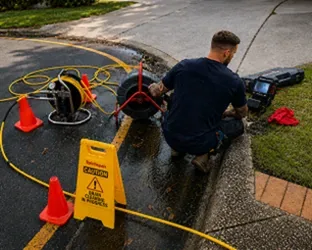
If the tree is staying, the only durable fix is closing the way in. Clear the line, film it, find the openings, and seal them.
That sequence is the whole strategy here, and it is why the camera comes earlier in this shire than it might elsewhere.
Sealing is covered on the relining page, and it is the part that turns a recurring cost into a finished job.
Backing onto a reserve changes the odds
A great many properties here back onto bushland or a reserve. The trees on that side are not yours, they are not going anywhere, and their roots are in the same ground your line runs through.
So on those blocks the tree question is settled before it is asked, and the only variable is the condition of your own pipe.
That is worth knowing, because it removes an option people otherwise spend time considering.
Which fixtures, and how often
A single slow basin is that fixture and its trap. Several, or the lowest fixture in the house, is the main line out telling you so.
Once is an event. Three times in a year at the same point is a defect describing itself, and in this shire the description is usually roots at a joint.
Keep a rough note of the dates. A shortening interval between clearances is the clearest signal there is.
Rain or no rain splits the diagnosis
A sewer blockage is indifferent to the weather. Trouble that only arrives in a downpour and eases when it stops is the stormwater side.
Under heavy canopy, wet weather trouble is very often gutters, downpipes or a stormwater pit loaded with leaf litter rather than the sewer at all.
That is a much cheaper problem, and saying which one you have gets the right equipment to a property that may be a long drive.
Leaf litter, and why pits fail early here
Lift the grate on a stormwater pit and it can look serviceable while passing almost nothing, because wet litter packs down and behaves like a mat rather than a pile.
Under the canopy in this shire that happens faster than it does on an open block, and not only in autumn, because eucalypts shed all year.
So pits here are worth clearing on a schedule rather than on appearance, once a year before the wet months.
Wipes and kitchen fat, still
Wipes remain the largest single cause of what we cut out of drains regardless of what the packet claims, and heavy tree cover does not change that.
Kitchen fat is the slower version, narrowing the bore until a line that had been getting worse for a year finally stops.
On a line already carrying root mass at the joints, both cause trouble sooner than they would on a clean pipe.
What the footage settles
How many openings there are, where they sit, and whether the pipe between them is sound. Those three decide whether this is a patch, a lined run, or a schedule of clearances.
The recording is yours whatever it shows, and where the honest answer is that clearing annually is cheaper than repairing, we will say so.
On a property where the tree is staying, knowing exactly where the roots are getting in is the whole basis of the decision.