Local leak guide
What actually goes wrong with pipes in Hornsby
Roots go for pressurised lines too
Most writing about roots concerns the sewer, because that is where they cause obvious trouble. They are equally interested in a weeping water service.
A pressurised line that has developed a small leak becomes a reliable source of moisture in otherwise dry ground, and roots find it.
So on a bush block a leak and a root problem can be the same problem, and the repair has to consider both.
The root zone is protected, not just the trunk
It is easy to assume that if the tree is staying, the ground around it is available. In practice the protected zone extends well beyond the trunk.
So excavating to reach a leak beneath a mature tree is not only difficult, it may require consent, and damaging significant roots can be an offence.
That constraint applies to water service repairs exactly as it applies to drainage, and it is worth establishing before planning a dig.
On a bush block, the leak may never surface where you look
Escaping water follows the ground. On a sloping, vegetated block it can travel a long way through leaf litter and topsoil before it appears anywhere.
And on ground that is damp under canopy anyway, it may not appear at all in any way anybody would notice.
So looking for a wet patch works poorly here, and its absence is not evidence of anything.
Persistent damp is not always shade
Under heavy canopy, ground stays wet longer and people reasonably attribute a permanently damp patch to lack of sun rather than to a leak.
Which means a genuine loss can go unnoticed for a very long time on exactly the properties where the ground gives least away.
The meter test separates the two cleanly and it costs nothing, which is why it comes first.
The meter is the honest test
Shut every tap and appliance and watch the meter for a quarter of an hour. Movement with nothing running means water is genuinely leaving on your side.
Turn any irrigation off entirely rather than to a rest day, or it will run during the measurement and confuse the result.
On a property where nothing above ground will tell you, this is close to the only reliable signal available.
Isolating the hot water, and reading again
Close the inlet valve at the hot water system, leave everything else as it was, and watch the dial for another couple of minutes.
Continued movement is the cold side. Movement stopping is the unit itself or the hot pipework beyond it.
One thing to rule out first on a hot result: a relief valve dribbling steadily gives the same reading and is a small, cheap repair rather than a hidden leak.
Why we listen along the pipe rather than dig at the damp
Water from a slow leak travels before it surfaces, so the visible damp is where it got out rather than where it left the pipe, and on a slope those can be well apart.
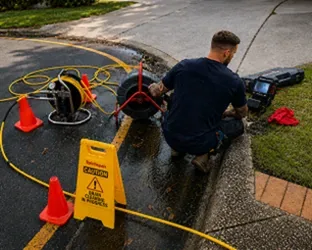
Acoustic listening follows the line itself, picking up the sound a pressurised leak makes through soil.
On ground where excavation is constrained by tree protection, locating precisely is not a convenience. It is what makes a repair possible at all.
Long service runs on acreage
A house set back from the road can be a considerable distance from its meter, and every metre of that run is private pipework and the owner's responsibility.
That is the single largest piece of pipe most rural-fringe owners have, and it is entirely buried.
The bill is frequently the only symptom a failure on it produces, which is why a jump with no change in habits is worth acting on.
Find your stop tap before you need it
On acreage the meter can be a long walk from the house, in the dark, in the rain, at two in the morning.
Find it on a dry afternoon, check the tap actually turns, and leave a torch somewhere you will remember.
Learn the isolating valves indoors too, because closing one handles a specific failure without the walk.
Flexible hoses are the urgent item
The braided hoses under vanities and behind cisterns last around five years and fail all at once, at mains pressure, frequently while nobody is home.
Out here, where a plumber is not fifteen minutes away, the value of preventing one is higher than it is closer in.
They are cheap and quick to replace, and doing them as a set makes sense because they went in together.
Reading a damp patch correctly
It tells you there is a leak. It does not tell you where, and assuming otherwise leads to an opening in the wrong place followed by a second one.
Water travels along joists, studs and slabs, taking the path the building gives it, and surfacing at the weakest point rather than the nearest.
Locating properly first costs a fraction of opening the wrong surface once, and on any original or expensive finish the difference is considerable.
Ask for it in writing before we leave
A written account of the fault, its location and the repair is straightforward to produce while somebody is still on site and effectively impossible later.
It supports an application to Sydney Water for a concealed leak allowance, where the circumstances meet their criteria, and it supports a claim if one follows.
Whether you qualify for anything is not ours to say. Having the evidence is.