Local relining guide
What relining actually is, and why it suits Hornsby
How it works, without the brochure language
A resin-saturated liner goes into the damaged section, is inflated against the existing pipe wall, and cures there into a new pipe formed inside the old one.
Continuous, smooth, slightly smaller in bore, and structural in its own right rather than a coating over a problem.
It goes in through existing access, so no ground is opened and no root zone is disturbed.
Why cutting roots alone does not hold
A root cutter clears what is inside the pipe today. It does not change the opening they came through, and roots grow back towards the same moisture.
So the interval between clearances shortens, which is the pattern people notice before they understand it.
Sealing the openings is the only version of this repair that ends the cycle while the tree stays where it is.
The three metre exemption, and why it usually misses
Hornsby allows removal without a permit where the trunk is within three metres of an approved dwelling, among other conditions.
The trees causing drainage trouble are rarely that close to the house. They are along the line between the house and the boundary, which is exactly where the exemption does not reach.
So the exemption exists and it usually does not help with this particular problem, which is worth knowing before anybody plans around it.
Where exemptions fall away entirely
Inside a Heritage Conservation Area, a Locally Significant Ecological Community, or on a property with other overlays, the ordinary exemptions can fall away.
In those situations removal is a formal process with an uncertain outcome rather than a decision an owner can make.
Which makes a repair that leaves the tree entirely alone considerably more attractive than it would be elsewhere.
A liner removes every opening at once
Cured in place it is continuous along the lined section, so there is nothing left for a root to enter through anywhere along that run.
That is the difference between treating this season's growth and removing the mechanism, and it is why a liner carries a design life measured in decades.
On a property where the tree is not going anywhere, it is the only durable answer.
Patch, or the whole run
Roots are usually opportunistic rather than comprehensive. One tree finds one joint, and the rest of the line is untouched.
Where the camera shows that, a patch liner over the affected section is the proportionate answer and it is considerably cheaper than lining the run.
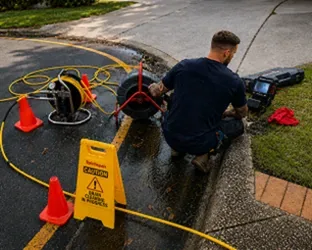
Where openings appear along the length, lining the run is the honest recommendation. The footage decides, and you should see it.
What relining cannot do
It restores the pipe. It cannot change the gradient the pipe was laid at, because the liner takes the shape of the host it cures inside, settled sections included.
So a run that films as sound but keeps holding water in one place is a fall problem, and no liner addresses it.
Grade gets checked from the footage before a quote is written, and where it is the issue we will say so.
A collapse needs the section replaced
A liner needs a host holding roughly its original shape to be formed inside. A crushed length has nothing to form against and has to come out.
In this shire that is the scenario worth establishing early, because it is the one that brings tree protection and excavation consent back into it.
A short open repair plus a liner over the remainder keeps the digging to one small place.
Junctions get reopened after the liner cures
The liner passes over each branch connection on the way in and each is cut back open from inside once the resin has set. Routine, and confirmed on camera.
A missed one stops the branch it serves draining, which is immediately obvious rather than hidden.
You keep the after footage, which is how you check the junctions are open rather than taking anybody's word for it.
Why we quote both ways
You should be able to compare, so both figures come together for the same defect, with the length in metres and what each includes.
On a bush block the excavation figure also has to account for what the tree protection controls allow, and occasionally the honest answer is that it is not permitted at all.
If a quote offers only one method, ask what the other would cost and why.